

When people find out I am a physiotherapist, they often ask me for advice. I truly don’t mind when this happens. I love helping people in whatever form that takes. So one day at the court when someone asked me about their elbow pain, I was happy to take a few minutes to chat.
The thing is, I was not at all surprised that this particular person had some kind of pain in the arm. You see, as a physiotherapist I just can’t help myself. No matter where I am or what I’m doing, I am constantly analyzing how other people move. This is the reason I absolutely cannot ever go to a gym. Watching people do things with imperfect form that I know will lead to injury is simply excruciating for me. I would have to go with blinders on.
My physio brain had picked up on a few things that day watching the person with the sore elbow. To be clear, this is a formidable player with an absolutely wicked serve that I was struggling to return, amongst myriad other skills. However, I could see that most of their power was being produced strictly with the arm.
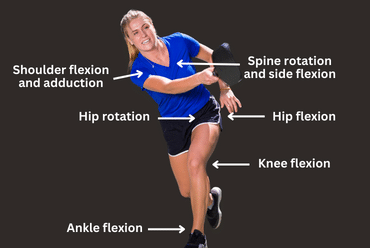
So how should we generate power in a pickleball shot? As a general rule, power comes from the ground up in what is called a kinetic chain. Our legs and pelvis should be the primary generators. Power is then transferred (and can be amplified) through the core, and lastly it travels through the arm to the paddle. The arm itself should not be doing most of the work, your lower body should.
When you rely solely upon your arm for power, it makes perfect sense why some part of it would start protesting. Watching the person in question, I could plainly see (well it’s really only plain to a physio geek like me) that the lower body and trunk were not being optimally utilized.
I tried briefly to explain this, but it’s such a foreign concept that I understand why it confuses people. We are so programmed to believe that if your elbow hurts it’s only the elbow that needs treatment. And then, here’s the kicker – the part that unfortunately makes me look like an ambulance chaser. If this person goes to pretty much any other physiotherapy clinic, they will treat the elbow when the elbow is absolutely not the problem. This issue needs a holistic approach that looks at fully body movement patterns, and sadly very few physiotherapists do this.
So I end up recommending they come and see me, which looks bad and I understand why. It makes it sound like I think I’m the most amazing therapist ever and no one else can help. That’s not at all what I’m saying. What I’m saying is that most of my profession quite frankly sucks in looking at the whole body to find the true underlying cause of the problem, and instead they just treat the symptoms. They treat body parts and not people. I know this to be true because I too was trained that way. I just got wiser in my old age. If you’d like to know more about that journey, check out this blog.
Apparent self-aggrandizing aside, I always look at a person’s whole body. We are connected head to toe, and dysfunction in one area will always lead to a problem in another. The skill in assessment is to connect it all. In the end the person with the sore elbow never came to see me, and I completely understand why.
Getting back to the mechanics of it all, upper body overuse injuries in pickleball often involve the wrist, elbow, and shoulder. Let’s look a little more closely at what might be happening here. The main issue is less than optimal technique, but the real question is what is underlying the challenges in technique? It could be that the player just doesn’t know how to do it better. It could also be that their body has limitations that actually prevent them from doing it properly. The first will be solved with some lessons. The second will not.
As an example of the first scenario, when I started playing pickleball, I didn’t have a clue what I was doing. It wasn’t long before I developed wrist pain. Of course I blamed my paddle for being too heavy, but it wasn’t that. After taking a clinic I realized I was flicking my wrist with every shot when at the net. Since correcting this issue, I have not had any wrist pain.
The second scenario often leads to a lot of frustration. You go to a pickleball clinic or invest in expensive private lessons. The instructor shows the proper technique but try as you might you can’t get it. You practice over and over but it just doesn’t come. The instructor keeps repeating something like “rotate your upper body more,” and you become increasingly annoyed that you can’t do it. Well has it ever occurred to anyone it’s because you CAN’T? Maybe your body can’t actually go there at all or can’t go there without messing up your balance. Or worse yet, maybe you force it to go somewhere it doesn’t want to go due to restriction in the tissues, and the next day you can’t get out of bed. Does any of this sound familiar?
The truth is that really good pickleball technique in all of the various shots we employ requires a tremendous amount of balance, strength, flexibility, stability, and mobility. That is quite a laundry list of assets. Do you have to have all of those things to perfection to avoid injury? Heck no, but a reasonable amount of each is your best bet for staying healthy on the court.
Most importantly, you need to think about generating power from the ground up. When you are hitting a drive, you should be aware of your legs and the muscles around your trunk and pelvis working. You might think that when using your soft game this doesn’t apply, but that is incorrect. Dinking involves a whole lot of fine motor control for finesse, and one does not have fine motor control without a solid base from which to operate. Think about this like a crane. If the base of the crane is unstable, then the arm is going to be all over the place. If you are not engaging your legs and pelvis at the kitchen line, then the fine control of your soft game isn’t going to be there. Definitely don’t be dumb like me and flick your wrist to compensate.
To summarize, the key to avoiding upper body overuse injuries in pickleball is to ensure you are generating power with your lower body and that your lower body is a nice solid base for your soft game. Finding out what might be preventing you from doing this is where a full body assessment comes in. And if in the end, you are generating power properly and still have, say, shoulder pain, then maybe there truly is a problem with the alignment there. Perhaps you had a previous injury to the shoulder and proper movement patterns were never fully restored. Then when you decided to take up pickleball in retirement your shoulder started bothering you again. Old injuries often rear their ugly heads later because the treatment you had was aimed at alleviating pain and not at fully restoring proper movement patterns. I see this often in my practice.
In the end we may actually end up treating the area that hurts, but you certainly can’t start there. I know from experience (too many years to count) that where it hurts is pretty much NEVER the problem. It’s just the part of you that’s paying the price. Looking at things piecemeal just doesn’t work.
And regarding the person with the elbow pain, if they can generate that much power just with their arm imagine what they could do if they mastered generating power from the ground up. No one would want to be staring down that serve.